Toleo la Wajenzi: Afrika Inasimamisha Vifaa Vyake Mwenyewe
Introduction
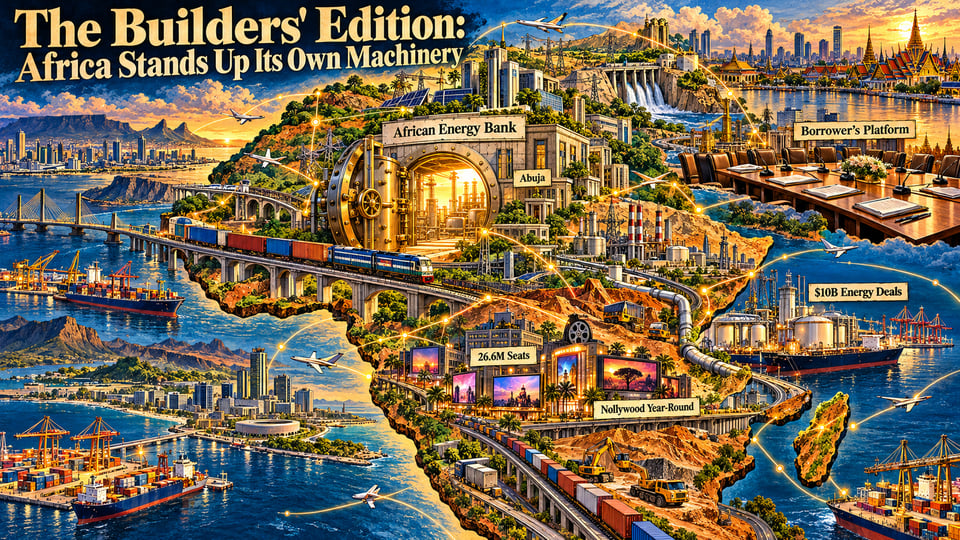
Two weeks ago this Signal argued the money is coming home. This fortnight showed what the money is becoming: machinery. In Cape Town the deal floor closed on about $10 billion in energy transactions and a date was set for a continental energy bank to open its doors in Abuja. In the venture market Nigeria retook Africa's funding lead as logistics, the business of moving real things, overtook fintech for the first time in seven years. On the airways, 26.6 million scheduled seats made October the continent's biggest flying month on record, and a cinema industry that used to live in December posted records in May and October. Bangkok's borrowers, chaired by a Nigerian finance minister, began organizing their own debt table. An Ebola outbreak tested the response machinery and found African systems performing under strain. A former governor told diasporans to say no to money requests from home, and three parties answered within 48 hours. And two discoveries, a 4,400-year-old Saharan tomb and two colossi of Ramses II, kept the archive moving. The third edition of the Signal walks all six sections of the African fortnight, with twenty-three references and no borrowed voices. Pro-Africa, evidence-first, and in our own voice: leverage funded the decade; now the decade is being built.
African Culture and Heritage

The year Nollywood stopped waiting for December
Nigeria's cinema industry is projected to pass N20 billion in box office revenue in 2026, up at least 28 percent from N15.6 billion in 2025[1]. The first half of the year alone generated about N8.8 billion, more than any full year between 2019 and 2023, with the ten highest-grossing local films earning over N2.26 billion[1]. The composition is the story: the records are falling outside December, the month that used to carry the entire theatrical year.
Two films mark the shift. Call of My Life, released in May, passed N900 million to become the year's biggest Nollywood title, the first non-December release ever to cross N600 million, and held number one for six consecutive weekends[1]. Agbara Nla: The Return, a faith-based remake, opened on 1 October with N170.6 million including previews, the biggest non-December opening on record, and by 16 October had passed N307.2 million as the highest-grossing Nollywood film ever released in October[1][2].
A film economy that only monetized in December was a festival. One that opens records in May and October is infrastructure: year-round screens, year-round audiences, year-round working producers. The Signal's read, stated as our own: the question this newsletter posed at Lagos Fashion Week's CRAFTED announcement, whether attention converts into year-round African market machinery, has already answered itself at the cinema. The checkpoint now is distribution depth, whether screens multiply beyond Lagos and the big cities fast enough to hold these totals.
Travel and Exploration
The schedule thickens
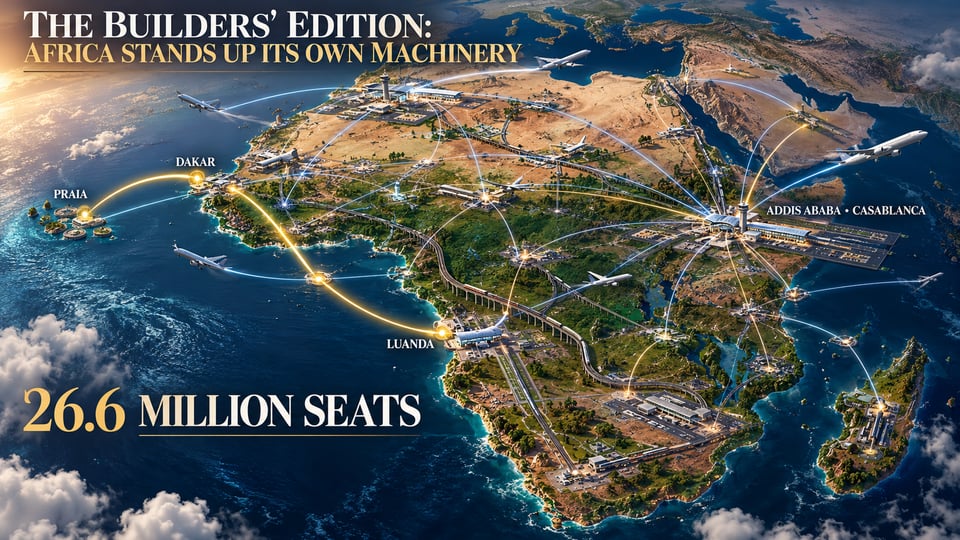
Africa's scheduled airline capacity reached 26.6 million seats in October 2026, per OAG schedules data[3][4]. Ethiopian Airlines remains the continent's largest carrier with 2.1 million seats, up 6.0 percent year on year, while Royal Air Maroc grew 20.6 percent and easyJet entered the top ten at plus 23.2 percent[3]. Lagos and Casablanca are the fastest-growing airports among the ten largest, and Hurghada has returned to that top ten[3][4].
The map is also filling in at the edges. Five days after this issue publishes, TAAG Angola Airlines launches a Luanda-Dakar-Praia route on 31 October, reconnecting Angola and Cape Verde after about a decade and adding Senegal to its network[5][6]. The carrier frames the corridor as a new air bridge between African countries[6]. It is the Atlantic counterpart to the eastern-hub expansion this newsletter tracked last issue: a day earlier, on 27 October, Ethiopian opens its Nacala service to northern Mozambique, and the first load-factor readings will show whether the secondary-city thesis pays.
Capacity is the leading indicator. Seats scheduled are trips that will be taken, cargo that will move, itineraries that can actually be sold, and this month there are more of them than ever. Two hubs are pulling the growth: Addis Ababa's steady compounding and a Casablanca surge that shows North African infrastructure competing for transfer traffic. Watch whether the Praia service holds past the northern winter, and whether October's record becomes the baseline rather than the peak.
History and Identity
The archive moves again, at both ends of the map
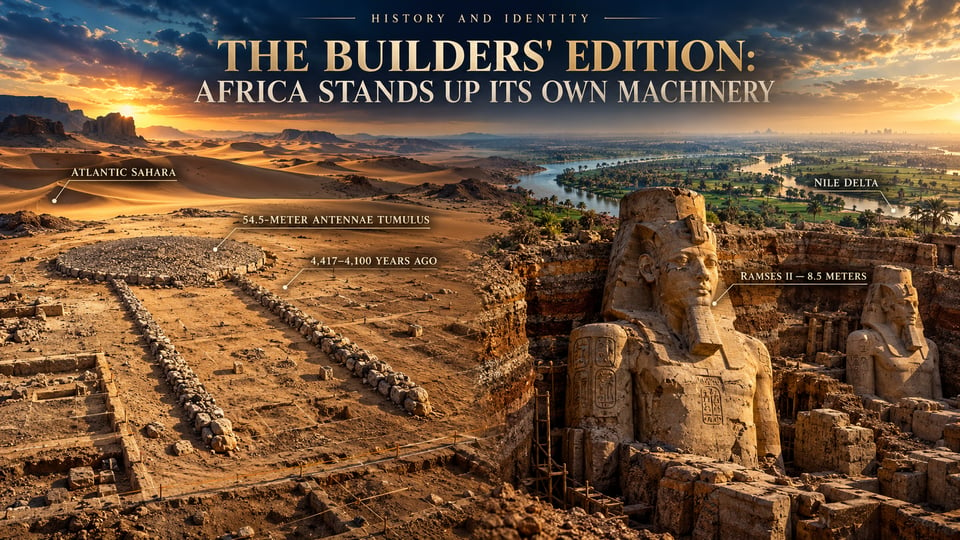
For the second consecutive issue, the continent's deep past moved inside a single news cycle. In the Atlantic Sahara, research published 20 October in African Archaeological Review delivered the first absolute chronology for an "antennae tumulus," a monument class that has resisted dating for a century: two radiocarbon dates place the burial at Wadi Lawash el Telli between about 4,417 and 4,100 years ago[7][8]. The 54.5-meter monument combines an oval mound with two long stone rows, built from local limestone without mortar; the team led by Joaquim Soler of the Catalan Institute for Cultural Heritage Research notes a small group could have assembled it[8]. Beneath the mound lay an undisturbed burial, one individual aged 25 to 35, accompanied only by four ostrich-eggshell beads, and the study pointedly declines to claim an astronomical function despite the alignment[8].
At the other end of the continent, in the Nile Delta, Egypt's antiquities authorities announced the remains of two colossal royal statues at Behbeit el-Hagar, one identified as Ramses II, about 8.5 meters tall with a royal head of roughly 1.60 meters[9][10]. The excavation began because a resident reported an inscribed pink granite block on farmland, and the find now deepens the record of New Kingdom presence in the Delta[9].
Last issue it was a Ramesside tomb at Luxor and a 4,000-year-old wall in Morocco; now a Saharan monument class has its first calendar and the Delta has new colossi, found through a farmer's report. The pattern holds: every time the record is measured rather than assumed, African societies of the deep past prove more organized, earlier, and more widespread than the old accounts allowed. And note how the finds arrive, through patient scholarship on undisturbed contexts and through citizens who call the ministry. Both are the archive widening.
Business and Opportunity

The bank opens, the lead changes
African Energy Week closed in Cape Town on 16 October with approximately $10 billion in disclosed energy deals, a figure announced by African Energy Chamber Senior Vice President Verner Ayukegba and not yet broken down independently[11][12]. The structural news was larger than the tally: the African Energy Bank, promoted by the African Petroleum Producers' Organization and Afreximbank, is expected to begin operations in November 2026 from Abuja with $500 million in initial capital secured and ambitions of mobilizing up to $10 billion, per APPO Secretary-General Farid Ghezali[11]. It targets exactly the projects global lenders retreat from: petroleum infrastructure, refineries, pipelines and gas. The event's Deal Room presented 15 projects seeking more than $16 billion, and Ghana reported crude output up about 30 percent under Energy Minister John Abdulai Jinapor[11].
The venture market rhymed. Nigerian startups raised $635 million across the first nine months, 2.6 times the $247 million of a year earlier, reclaiming the continental country lead as Kenya and South Africa contracted, and taking 37 percent of country-specific funding, Nigeria's highest share since 2021[13][14]. The deeper shift is sectoral: logistics and transport raised $780 million across Africa, edging past fintech's $760 million for the first lead change in seven years, from a 7 percent share just last year[14]. Four companies, Moove, Flutterwave, Jumia and Yellow Card, carried 69 percent of Nigeria's total, while 77 Nigerian startups raised at least $100,000, up from 70[14].
Issue 002 asked who funds the self-funded decade. This fortnight began answering with institutions. A bank with a balance sheet is a different instrument from deal-by-deal diplomacy, and capital rotating from moving money to moving goods is the real economy asserting itself. The Signal's read, stated as our own: read the concentration figures as closely as the headlines. The $10 billion is a convenor's tally, and four rounds carried most of Nigeria's lead. Direction is the signal; depth still has to be built. Checkpoints: whether the bank's capital grows beyond its first $500 million in 2027, and whether Nigeria's breadth holds when the mega-rounds pause.
Geopolitics and Global Standing
Three tests of the architecture
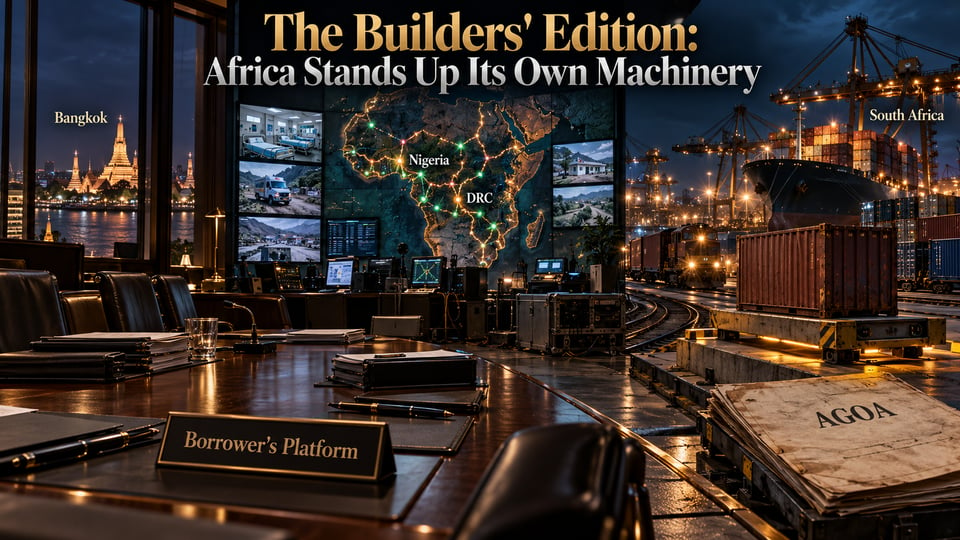
Bangkok first. The G24, the bloc of developing and emerging economies, released its communique on 13 October at the IMF-World Bank Annual Meetings, calling debt vulnerability a major barrier to inclusive growth[15][16]. The meeting was chaired by Nigeria's finance minister Taiwo Oyedele, quoted by Reuters warning that developing nations pay roughly $500 billion more for their debt than developed countries[15]. The bloc described unilateral sanctions as increasingly macro-critical, demanded early review of IMF charges and surcharges, and backed the new Borrower's Platform, whose inaugural Governing Council met in Bangkok with UNCTAD providing the secretariat[15]. Issue 002 watched Africa arrive at the multilateral season with a stronger brief; this is what leverage does with a pen: it starts writing rules.
Second, the hard test. The Ebola outbreak in the DRC, driven by the Bundibugyo virus, reached an eighth province, Nord Ubangi on the Central African Republic border, and has recorded 9,552 confirmed infections and more than 4,600 deaths since mid-May, with about six in ten deaths occurring outside health centres[17]. Nigeria confirmed its first case in a traveller from Uganda, becoming the fifth affected country, with more than 40 contacts traced and sequencing underway[17]. The curve is steep: this outbreak passed 1,000 confirmed cases within 40 days of response activation, against roughly 235 days for the 2018 epidemic[18]. And yet the response machinery is performing: Kenya traced 135 contacts of its one fatal case and, in the words of health chief Patrick Amoth, accounted for them "100 per cent," while Ervebo vaccine cross-protection research against Bundibugyo continues[17]. Severity is the headline; capability is the trendline. Both are true, and the gap between them is resourcing, not competence.
Third, the hedge. President Cyril Ramaphosa warned on 19 October that South Africa, among the largest users of the preference scheme, should prepare for the loss of AGOA trade benefits[19][20]. Read the three tests together and the lesson is shared: borrowers organized, responders responded, and a government priced in the loss of a privilege rather than pleading for its renewal. The external architecture is being treated as weather. African institutions are being built as climate.
Community and Connection
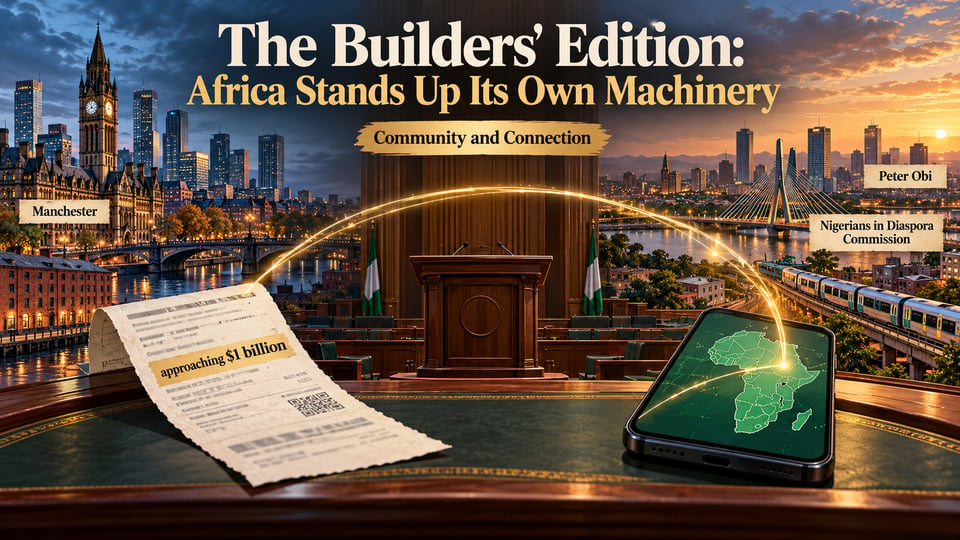
The family purse becomes a campaign issue
At a diaspora town hall in Manchester on 18 October, presidential candidate Peter Obi told Nigerians in the UK how to answer relatives asking for money: "Tell them no!"[21]. His argument was that remittances ease hardship without fixing the poor governance that causes it, and that diasporans should press families to back leaders with proven records[21]. The pushback took 48 hours. Labour Party's Ken Asogwa countered that diaspora money covers medical bills and school fees; the NNPP's Major Agbo said political disagreements should not undermine the economic support Nigerians abroad provide; the SDP joined the criticism[22]. Obi then denied asking anyone to abandon their families, saying his remarks were distorted and aimed at the conditions forcing dependence[22].
The same week, the Nigerians in Diaspora Commission put monthly inflows at approaching $1 billion, a government estimate that sits alongside IFAD's $22.8 billion annual reading from September[23]. Both sides of the argument now campaign on the same premise: diaspora finance is systemically important. Last issue documented the diaspora as Africa's largest private financier at an estimated $124 billion a year continent-wide; this fortnight that money became electoral politics in the continent's biggest market. The Signal's analysis, stated as our own: remittances are family finance, patient and counter-cyclical, and they will keep flowing because families are not portfolios. The real question inside the Manchester row is whether the state can convert that loyalty into infrastructure, schools, clinics, rails, fast enough to make the money requests less necessary. That is the 2027 campaign this exchange previewed, and this newsletter's business section is the ledger it will be argued over.
Liked this issue? Forward it to a colleague who needs to see Africa clearly.
Subscribe to The Noble Africa Signal
References
Nairametrics. "Nollywood: Meet 7 producers making box office history in 2026." https://nairametrics.com/2026/10/17/nollywood-meet-7-producers-making-box-office-history-in-2026/ Published 2026-10-17. Accessed 2026-10-25.
QNC News. "Agbara Nla: The Return Crosses N307 Million at the Box Office, Sets October Record for Nollywood." https://qncnews.com/2026/10/17/agbara-nla-the-return-crosses-n307-million-at-the-box-office-sets-october-record-for-nollywood/ Published 2026-10-17. Accessed 2026-10-25.
OAG. "African Aviation Market Data (October 2026 schedules)." https://www.oag.com/african-aviation-data Accessed 2026-10-25.
African Pilot. "OAG Schedules Put African Airline Capacity at 26.6 Million Seats for October 2026." https://africanpilot.africa/oag-african-airline-capacity-october-2026/ Accessed 2026-10-25.
TAAG Angola Airlines. "TAAG to Launch Luanda-Dakar-Praia Route." https://flytaag.com/en/Taag/Press-releases Accessed 2026-10-25.
360mozambique. "TAAG to Launch Luanda-Dakar-Praia Route in October." https://360mozambique.com/world/angola/taag-to-launch-luanda-dakar-praia-route-in-october/ Accessed 2026-10-25.
Soler, J., et al. African Archaeological Review. "First absolute chronology for an antennae tumulus at Wadi Lawash el Telli, Western Sahara." Published 2026-10-20. Reporting accessed 2026-10-25.
Arkeonews. "Mysterious 54-Meter-Long Stone Monument Discovered in Western Sahara Reveals 4,400-Year-Old Burial." https://arkeonews.net/mysterious-54-meter-long-stone-monument-discovered-in-western-sahara-reveals-4400-year-old-burial/ Published 2026-10-21. Accessed 2026-10-25.
Euronews. "Ramses II statue fragments found on Egyptian farmer's land." https://www.euronews.com/2026/10/20/egyptian-cucumber-farmer-helps-archaeologists-find-giant-ramses-ii-statue-fragments Published 2026-10-20. Accessed 2026-10-25.
Egypt Independent. "New discovery unearths statues of King Ramses II in Nile Delta." https://www.egyptindependent.com/new-discovery-unearths-statues-of-king-ramses-ii-in-nile-delta/ Accessed 2026-10-25.
Vanguard News. "AEW 2026 records $10bn in energy deals, advances African Energy Bank." https://www.vanguardngr.com/2026/10/aew-2026-records-10bn-in-energy-deals-advances-african-energy-bank/ Published 2026-10-19. Accessed 2026-10-25.
Africa Monitoring. "Africa Energy Week 2026 Concludes in Cape Town As Industry Looks Ahead." https://africamonitoring.com/news/economy/788 Published 2026-10-16. Accessed 2026-10-25.
Nairametrics. "Nigeria reclaims Africa's startup funding lead as investments rise to $635 million." https://nairametrics.com/2026/10/21/nigeria-reclaims-africas-startup-funding-lead-as-investments-rise-to-635-million/ Published 2026-10-21. Accessed 2026-10-25.
Business A.M. Live. "Nigeria leads Africa startup funding race with $635m in nine months." https://businessamlive.com/nigeria-leads-africa-startup-funding-race-with-635m-in-nine-months/ Published 2026-10-21. Accessed 2026-10-25.
Bretton Woods Project. "G24 communique analysis Annual Meetings 2026." https://www.brettonwoodsproject.org/2026/10/g24-communique-analysis-annual-meetings-2026/ Published 2026-10-20. Accessed 2026-10-25.
International Monetary Fund. "2026 Annual Meetings of the International Monetary Fund and the World Bank Group." https://www.imf.org/en/meetings/2026/annual Accessed 2026-10-25.
UN News. "DR Congo: Ebola responders under pressure as outbreak expands." https://news.un.org/en/story/2026/10/1168647 Published 2026-10-22. Accessed 2026-10-25.
US Centers for Disease Control and Prevention. "Ebola Outbreak: Current Situation." https://www.cdc.gov/ebola/situation-summary/index.html Accessed 2026-10-25.
Daily Maverick. "Ramaphosa signals fuel relief and warns of AGOA losses as elections loom." https://www.dailymaverick.co.za/article/2026-10-19-ramaphosa-signals-fuel-relief-and-warns-of-agoa-losses-as-elections-loom/ Published 2026-10-19. Accessed 2026-10-25.
The Rio Times. "South Africa Plans for US AGOA Loss." https://www.riotimesonline.com/south-africa-ramaphosa-agoa-loss-prepare-2026/ Published 2026-10-19. Accessed 2026-10-25.
Vanguard News. "'Tell them no': Obi urges UK-based Nigerians to stop sending money home." https://www.vanguardngr.com/2026/10/tell-them-no-obi-urges-uk-based-nigerians-to-stop-sending-money-home-2/ Published 2026-10-20. Accessed 2026-10-25.
Pulse Nigeria. "Peter Obi Faces Backlash Over Diaspora Remittance Comments." https://www.pulse.ng/story/peter-obi-diaspora-remittances-backlash-2026102009204970658 Published 2026-10-20. Accessed 2026-10-25.
TVC News. "NiDCOM: Diaspora Remittances Near $1bn Monthly As Investments Rise." https://www.tvcnews.tv/nidcom-diaspora-remittances-near-1bn-monthly-as-investments-rise/ Published 2026-10-20. Accessed 2026-10-25.