The Self-Funded Edition: Africa Finances Its Own Decade
Introduction
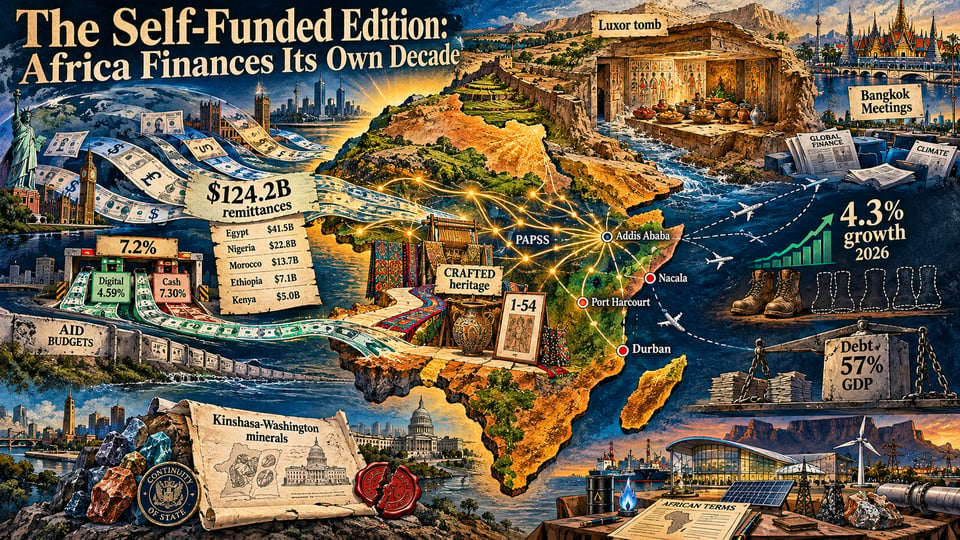
Two weeks ago this Signal argued that Africa's leverage is the story. This fortnight delivered the follow-up question: who funds it. The World Bank lifted its 2026 growth forecast for the region while warning, in the same breath, that growth still does not create enough jobs. The continent's venture market quietly flipped from lending to owning, with equity funding up 23 percent even as headline totals dipped. The diaspora sent home an estimated $124 billion, once again outgunning foreign aid. Cape Town opened the energy dealmaking season, Bangkok opened the multilateral season, and Kinshasa watched a former president tell the current one that an American signature is not a life sentence. Between those poles, the fortnight also delivered a Ramesside tomb emerging at Luxor, a 4,000-year-old wall rewriting Morocco's deep history, Lagos dressing itself in heritage, and Addis Ababa stitching three more cities into the continental map. The second edition of the Signal walks all six sections of the African fortnight, with twenty-three references and no borrowed voices. Pro-Africa, evidence-first, and in our own voice: the money and the story are both coming home.
African Culture and Heritage
The season Africa dresses itself
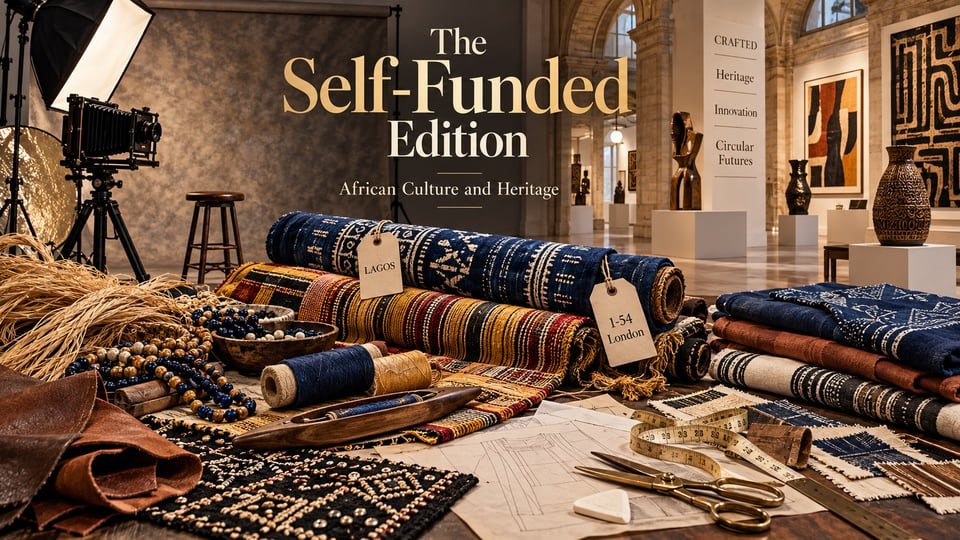
Lagos Fashion Week returns from 28 October to 1 November under a theme that does its own arguing: CRAFTED: Heritage. Innovation. Circular Futures [1]. The sequence is the thesis. Heritage craft knowledge is named first, as the input; innovation second, as the method; circular futures third, as the operating model. Five days at the LagosFW Tents at the Federal Palace Hotel will put runway shows, offsite presentations, and the Fashion Business Series behind one idea: African making as an industry, not a costume [1].
Two details mark the shift. The season campaign, photographed by Daniel Obasi, reinterprets the African studio portrait, a tradition of documenting identity, style, and culturally significant moments, placing craft and texture at the center of the frame rather than the margins [1]. And in the partner list sits the Africa Finance Corporation, a continental development financier putting balance-sheet weight behind African fashion alongside Heineken and NIVEA [1]. When development finance sponsors a fashion week, culture has stopped being the garnish and started being the plate. The platform's own description is explicit: LagosFW exists to drive the Nigerian and, ultimately, the African fashion industry, bringing buyers, media, and industry professionals into one commercial room [2].
The season does not stand alone. Four days before the first Lagos runway, 1-54, the leading international fair devoted to contemporary African art and its diaspora, opens its London edition at Somerset House, with previews on 15 October and public days through Sunday the 18th [3]. The continent-facing creative calendar now stacks across Lagos, London, and Paris inside a single fortnight, which means African cultural production is no longer requesting space in the international schedule. It is setting it.
The checkpoint for the next edition: whether CRAFTED's circular-futures language converts into measurable supply-chain practice, and whether October's attention translates into year-round African market infrastructure. Heritage is having its financing moment. Clothing it in enforceable standards is the next cut.
Travel and Exploration
The hub grows a second ring
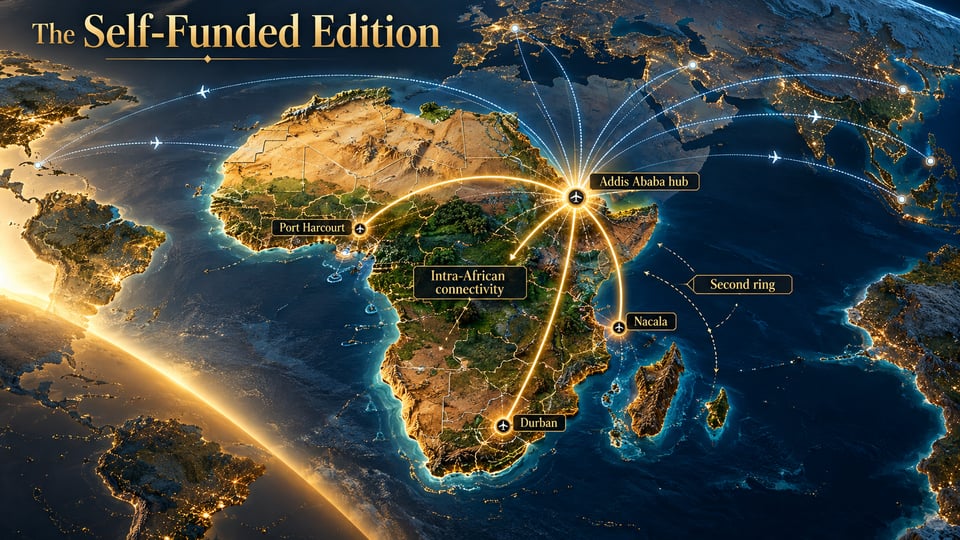
Ethiopian Airlines has confirmed three new African destinations for the closing quarter of the year: Nacala on 27 October and Port Harcourt on 1 December per the announced schedule [4], and Durban, where daily service resumes 11 December as the carrier's third South African destination after Johannesburg and Cape Town [5]. The airline frames the buildout as strengthening intra-African connectivity and, in its own words, advancing the vision of an integrated continent [5].
Count the routes, then read the pattern. Trade analysis of the buildout describes a hub-and-spoke strategy in its second ring: connecting secondary African cities that larger carriers overlook, then feeding that traffic onto long-haul services to Europe, Asia, the Middle East, and the Americas [6]. For passengers in the three cities, journey times to global destinations should improve considerably, with fewer connections [6]. For the continent, the mathematics matter more: intra-African travel remains the quiet bottleneck taxing every business trip, every tourist itinerary, and every supply chain that has to route through a third continent to reach a neighbor.
Each city on the list tells that story. Durban restores direct international depth to South Africa's busiest port city, on a daily schedule timed to connect through Addis Ababa the same day [5]. Port Harcourt deepens the Nigerian map beyond the Lagos-Abuja pair that absorbs most flying. Nacala opens a northern Mozambican port city that almost no global network serves at all. And as the analysis notes, improved intra-African connectivity is what makes multi-country itineraries practical to construct and sell, the difference between continent-scale tourism and country-scale tourism [6].
This is the layer underneath the rest of this issue. The capital moving in the business section, the diaspora flows in the community section, and the heritage travelers the culture section courts all travel on routes that either exist or do not. Waivers, as the last edition noted, open the doors; the network decides whether anyone can walk through them. Watch load factors on the Nacala service after its 27 October launch, and whether Durban's daily schedule holds through the southern summer.
History and Identity
Deep history, new chapters
Two discoveries bookending the continent compressed millennia into one month of headlines.
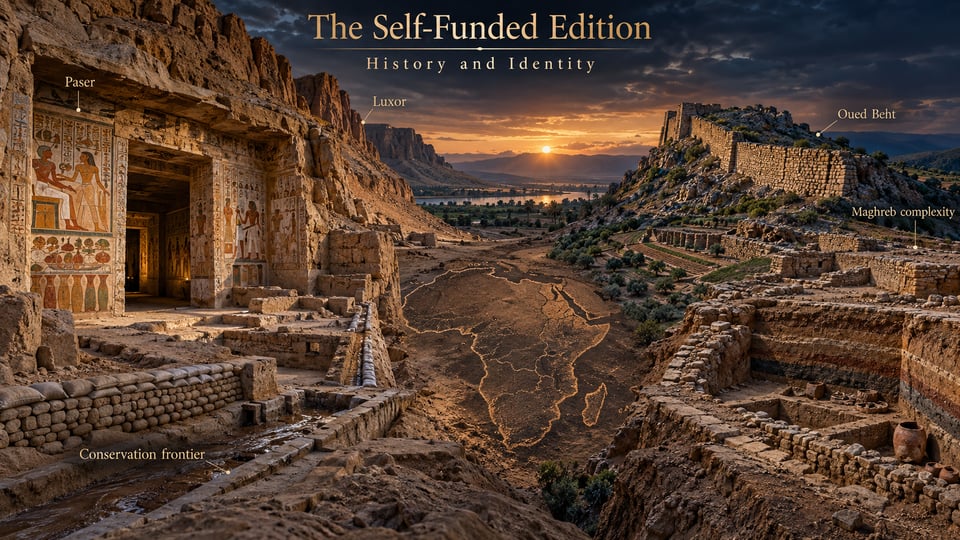
Near Luxor, an international mission working to protect ancient tombs from flash floods found something the flood-preparation manual did not expect: a previously unknown tomb, roughly 3,000 years old, its courtyard, rock-cut chapel, and burial chambers intact in the Theban necropolis of Lower Sheikh Abd el-Qurna [7]. The wall paintings show the tomb owner adoring deities and seated with his wife before an offering table laden with bread, beer, fruits, meat, and flowers, imagery that dates the tomb to the Ramesside period, ca. 1292 to 1069 BC [7]. First analysis identifies the owner as an official named Paser [7]. The mission has worked the necropolis since 2018 in collaboration with Egypt's Ministry of Tourism and Antiquities, and the find deepens a live research question: why Ramesside-era officials chose to build and reuse tombs beside the monuments of earlier elites [7].
In the hills of north-west Morocco, the Oued Beht Archaeological Project published something stranger: the earliest known large-scale construction of a probably defensive nature in north Africa beyond the Nile Valley, roughly 4,000 to 3,500 years old [8]. The site had already yielded what is likely the earliest and largest agricultural complex ever discovered in Africa outside the Nile Valley, dating some 5,400 to 4,900 years back [8]. Now it adds monumental architecture. The researchers read the wall as evidence of communities managing competition over land, resources, and movement, not repelling invaders, and conclude that Maghreb societies of the era were more complex and structured than previously believed [8]. The same ridge was rebuilt and reoccupied in the 11th to 13th centuries AD, a medieval chapter layered on the ancient one [8].
Read together, the finds attack the same assumption from both ends of the continent: that complexity in Africa was rare, late, or borrowed. The documented record keeps moving in one direction only, and this month it moved again.
The Luxor discovery carries a warning label worth its own paragraph. The tomb surfaced because climate-driven flash flooding now threatens the Theban necropolis; the same rains that water the present are erasing the archive [7]. Conservation, not excavation, is the new frontier of heritage sovereignty, a theme this issue's first section extends into the living economy of craft.
Business and Opportunity
Growth upgraded, capital re-priced
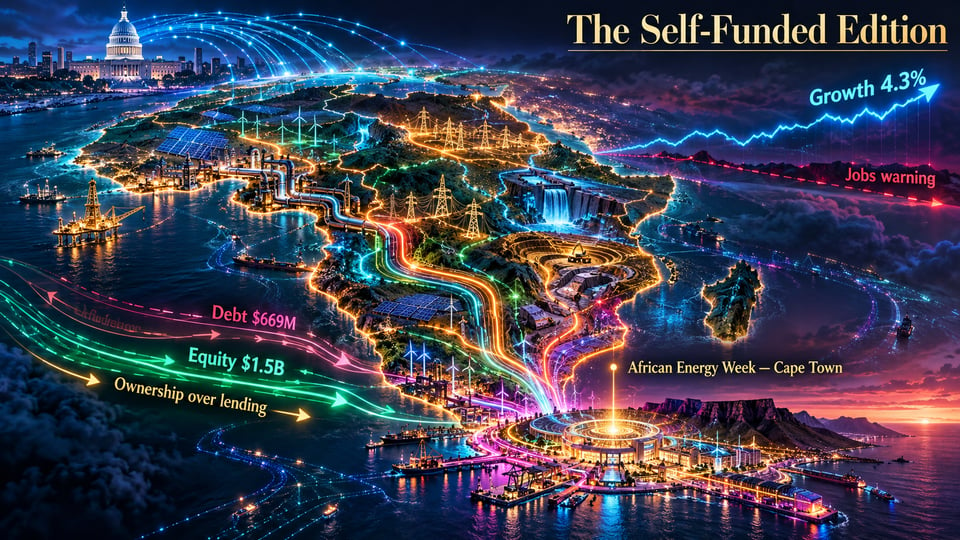
The fortnight's macro spine arrived on 6 October, when the World Bank's latest Africa Economic Update projected Sub-Saharan growth rising from 4.1 percent in 2025 to 4.3 percent in 2026, three-tenths of a point above its own April forecast, with upgrades for nearly three-quarters of the region's countries, including Angola, Ethiopia, Nigeria, and Zambia [9]. The report's honesty is what makes the upgrade credible: median inflation is projected to rise from 3.7 to 5.5 percent on global fuel, fertilizer, and food prices, public debt sits near 57 percent of GDP with debt service crowding out health and education, and the growth itself is still insufficient to cut extreme poverty or employ the region's expanding labor force [9]. The special focus chapter argues Africa's biggest artificial-intelligence opportunity is not frontier models but affordable, locally adapted small AI applications for education, agriculture, health, finance, logistics, and public administration, with adoption currently concentrated in Kenya, Nigeria, and South Africa [9].
While the Bank recalculated the macro, the venture market repriced the micro. African start-ups raised $2.16 billion across the first nine months of 2026, slightly below last year's pace, but the composition flipped: equity funding surged 23 percent to roughly $1.5 billion, 69.5 percent of the total and the strongest reading since 2022, while debt fell 33 percent to $669 million [10]. The third quarter was the year's strongest, 58 start-ups raising $582.8 million, even as the number of funded ventures thinned 19 percent [10]. The pattern extends the consolidation story the half-year data already told: fewer handshakes, bigger cheques, ownership over lending [11]. The Signal's read, stated as our own: a market that swaps debt for equity in a tighter year is not retreating, it is underwriting conviction. Investors accepting direct exposure in exchange for upside is how durable company-building gets financed.
The week's physical marketplace opened in Cape Town, where African Energy Week runs 12 to 16 October at the CTICC under the African Energy Chamber, with more than 9,000 delegates expected across oil, gas, power, renewables, critical minerals, and energy infrastructure [12] [13]. A growth upgrade in Washington data and a dealmaking floor in Cape Town in the same week is the continental economy arguing with itself in public: the numbers say 4.3 percent, and the room in Cape Town is negotiating who owns what that growth is built on.
One brief signal for the rails: dollar-pegged stablecoins have become central to Nigeria's payments flow, including remittances, operating under sandbox oversight [14]. This issue's final section explains why that matters at household scale.
Geopolitics and Global Standing

What the deal guarantees
Issue 001 reported Kinshasa standing up implementation machinery for its minerals partnership with Washington. This cycle the challenge came from inside the house. On Friday 9 October, former president Joseph Kabila delivered his second national address since leaving the country, reported from Goma, attacking the Tshisekedi government's record on security, institutions, and the economy [15] [16] [17]. He criticized the eastern military strategy as a war without prospect of victory, denounced constitutional change initiatives, and called for inclusive national dialogue [16] [17].
The passage that travels beyond Congolese politics concerned the minerals agreement. Kabila argued, per KT Press's rendering of the address, that the rights and obligations of the parties are guaranteed by the principle of the continuity of the state, not by the permanence of the regime in power [17]. The claim is both a legal observation and a political weapon: states bind themselves, governments come and go, and no signing ceremony confers tenure. He accused the government of reading an American signature as lasting political backing, criticized what he called a sell-off of critical minerals, and cited, as his own figure, public debt above $18 billion [17]. The address's occurrence, date, and Goma location are corroborated across RFI, Radio Okapi, and KT Press, logged in this issue's validation ledger; KT-Press-only details are attributed here, not asserted. KT Press is Rwanda-based, and DRC-Rwanda relations are a matter of standing dispute; this Signal reports the speech and asserts no state positions on any side. The context is the US-brokered Washington Accords framework signed on 4 December 2025, which pairs minerals cooperation and economic partnership with security commitments [18].
The Signal's analysis, stated as our own: the minerals story has entered its second act, and the second act is domestic. The first act was leverage, task forces and forums and framework agreements. The second act is the question every resource partnership eventually meets: what exactly does the counterparty guarantee, and to whom? Kabila's answer is aimed at a successor, but the question belongs to every African state negotiating critical-minerals access, and every capital negotiating it with them. Partnership that binds states can outlive governments; partnership that props up governments will be priced accordingly.
The same Monday the address rippled through Kinshasa, the multilateral season opened in Bangkok, where the IMF and World Bank Annual Meetings run 12 to 18 October with more than 15,000 delegates from 191 countries, an agenda featuring job creation, artificial intelligence, private investment, and the future of global development [19]. Africa arrives with a stronger brief than usual: its own growth upgrade, a $124 billion private capital base, and margin platforms like Africa's Voice, a high-level convening series co-convened at the Meetings to press African priorities into the agenda [20]. Watch for communique language on quotas, concessional finance, and AI governance, and for AEW's Cape Town closing declarations on African ownership thresholds. Leverage, as the first edition argued, compounds; this fortnight tested where it holds.
Community and Connection
The $124 billion family
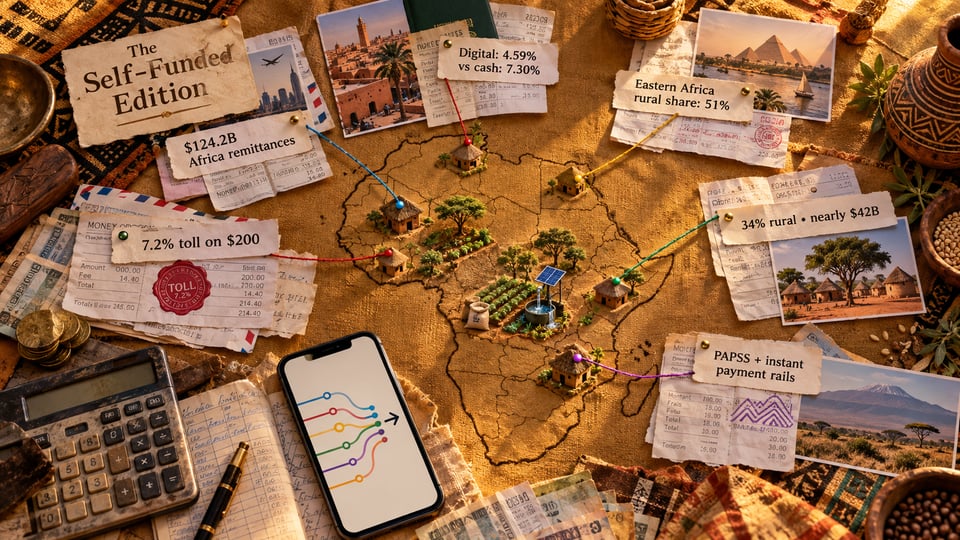
The quiet giant of this issue arrived in a report titled Sending Money Home 2026 from the International Fund for Agricultural Development. Globally, remittances reached $728.6 billion in 2025, nearly double the 2016 figure, connecting more than 1.3 billion people, one in six worldwide, with an estimated $233 billion landing in rural areas [21]. Africa's share is an estimated $124.2 billion a year, up 86 percent over the decade [22]. Egypt leads at $41.5 billion, followed by Nigeria at $22.8 billion, Morocco at $13.7 billion, Ethiopia at $7.1 billion, and Kenya at $5.0 billion; together, about 73 percent of the continental total [22].
What distinguishes the flow is not the size but the character. It is private, family-financed, and counter-cyclical, arriving when aid budgets waver and portfolio capital flees; IFAD now counts remittances as the world's largest and most resilient source of household finance, outpacing foreign aid [23]. About 34 percent of Africa's inflows, nearly $42 billion, reach rural communities, and in Eastern Africa the rural share is 51 percent, support landing precisely where banking infrastructure and safety nets are thinnest [22]. In Senegal, Mali, and Kenya, the report documents remittance-receiving households saving at higher rates and adopting climate-smart farming, drought-resistant crops, and solar irrigation faster than their neighbors [22].
The scandal is the toll booth. Africa remains the most expensive place in the world to send money: 7.2 percent on average for a $200 transfer in late 2025, against a global development target below 3 percent, with Southern Africa's 10.4 percent the worst subregional rate on earth [22]. The report's own data indicts the fix as well as the failure: fully digital transfers average 4.59 percent against 7.30 percent for cash-based services, yet digital corridors still account for only about a third of the sample [22]. The rails are the policy. IFAD points to PAPSS and regional instant payment networks as the route to cheaper intra-African transfers [22], and the stablecoin channels now carrying Nigerian remittance flow, noted in this issue's business section, are the market building the same answer from below.
The Signal's analysis, stated as our own: the development world inverted while nobody was watching. The diaspora is now Africa's largest, most patient, most reliable financier, and it taxes itself for the privilege through transfer costs no treasury would tolerate. Cutting those costs is not customer service; it is the cheapest development program on the continent, worth billions a year, already funded by the families who send the money. The self-funded decade is not a forecast. It is a remittance receipt.
Liked this issue? Forward it to a colleague who needs to see Africa clearly.
Subscribe to The Noble Africa Signal
References
LuxuryNext. "Lagos Fashion Week Announces 2026 Season with CRAFTED: Heritage, Innovation and Circular Futures." https://www.luxurynext.com/lagos-fashion-week-announces-2026-season-with-crafted-heritage-innovation-and-circular-futures/ Published 2026-10-05. Accessed 2026-10-12.
Lagos Fashion Week. "LagosFW, The Future Starts Now." https://lagosfashionweek.ng/ Accessed 2026-10-12.
1-54 Contemporary African Art Fair. "1-54 London 2026." https://www.1-54.com/london/ Accessed 2026-10-12.
Hypertext. "Ethiopian Airlines expands to more of Africa, including Durban." https://htxt.co.za/2026/09/ethiopian-airlines-expands-to-more-of-africa-including-durban/ Published 2026-09-29. Accessed 2026-10-12.
Ethiopian Airlines. "Ethiopian Airlines set to Resume Flights to Durban, South Africa." https://corporate.ethiopianairlines.com/Press-release-open-page/ethiopian-airlines-set-to-resume-flights-to-durban-south-africa Published 2026-09-29. Accessed 2026-10-12.
Travel News Africa. "Ethiopian Airlines Adds Nacala, Port Harcourt and Durban to Its Growing African Network." https://travelnews.africa/news-single.html?id=18527 Accessed 2026-10-12.
ScienceDaily. "Archaeologists find a 3,000-year-old Egyptian tomb before it's too late." https://www.sciencedaily.com/releases/2026/09/260909231746.htm Published 2026-09-26. Accessed 2026-10-12.
The Conversation. "History is being rewritten at an archaeological site in Morocco. What the discovery of an ancient wall tells us." https://theconversation.com/history-is-being-rewritten-at-an-archaeological-site-in-morocco-what-the-discovery-of-an-ancient-wall-tells-us-278911 Published 2026-09-15. Accessed 2026-10-12.
World Bank Group. "Economic Growth in Sub-Saharan Africa Gains Momentum Despite Global Uncertainty." https://www.worldbank.org/en/news/press-release/2026/10/06/economic-growth-in-sub-saharan-africa-gains-momentum-despite-global-uncertainty Published 2026-10-06. Accessed 2026-10-12.
Further Africa. "African start-up funding tilts toward equity in 2026." https://furtherafrica.com/2026/10/09/african-start-up-funding-tilts-toward-equity-in-2026/ Published 2026-10-09. Accessed 2026-10-12.
TechCabal. "State of Tech in Africa H1 2026 recap: Is consolidation the new growth story?" https://techcabal.com/2026/07/21/state-of-tech-in-africa-h1-2026-recap-is-consolidation-the-new-growth-story/ Published 2026-07-21. Accessed 2026-10-12.
African Energy Chamber. "African Energy Week 2026, Cape Town, 12-16 October." https://aecweek.com/ Accessed 2026-10-12.
The Rio Times. "African Energy Week 2026: Cape Town, 12-16 October." https://www.riotimesonline.com/african-energy-week-2026-cape-town-cticc-12-16-october/ Accessed 2026-10-12.
Further Africa. "How Dollar Stablecoins Became Nigeria's Payment Backbone." https://furtherafrica.com/2026/10/11/how-dollar-stablecoins-became-nigerias-payment-backbone/ Published 2026-10-11. Accessed 2026-10-12.
RFI. "La situation de la RDC n'a cesse d'empirer, l'ancien president Joseph Kabila tance Felix Tshisekedi." https://www.rfi.fr/fr/afrique/20261009-la-situation-de-la-rdc-n-a-cess%C3%A9-d-empirer-l-ancien-pr%C3%A9sident-joseph-kabila-tance-f%C3%A9lix-tshisekedi Published 2026-10-09. Accessed 2026-10-12.
Radio Okapi. "Joseph Kabila accuse Felix Tshisekedi de poursuivre une guerre sans perspective de victoire." https://www.radiookapi.net/2026/10/09/actualite/politique/joseph-kabila-accuse-felix-tshisekedi-de-poursuivre-une-guerre-sans Published 2026-10-09. Accessed 2026-10-12.
KT Press. "Kabila Tells Tshisekedi: U.S. Minerals Deal Doesn't Guarantee Your Regime Survival." https://www.ktpress.rw/2026/10/kabila-tells-tshisekedi-u-s-minerals-deal-doesnt-guarantee-your-regime-survival/ Published 2026-10-09. Accessed 2026-10-12.
U.S. Department of State. "Assistance Provided in Support of the Peace Agreement Between the Democratic Republic of the Congo and the Republic of Rwanda." https://www.state.gov/wp-content/uploads/2026/08/Report-Peace-Agreement-Between-the-Democratic-Republic-of-the-Congo-and-the-Republic-of-Rwand-1.pdf Published 2026-08. Accessed 2026-10-12.
International Monetary Fund. "2026 Annual Meetings of the International Monetary Fund and the World Bank Group." https://www.imf.org/en/meetings/2026/annual Accessed 2026-10-12.
Nkafu Policy Analysis. "Africa's Voice at World Bank/IMF Annual Meetings." https://africa.nkafu.org/ Accessed 2026-10-12.
International Fund for Agricultural Development. "Sending Money Home 2026: Beyond remittances, from lifeline to resilience, one family at a time." https://www.ifad.org/en/web/publications/sending-money-home-2026 Accessed 2026-10-12.
Capital Newspaper Ethiopia. "Remittances to Africa reach $124 billion as digital channels lower transfer costs." https://capitalethiopia.com/2026/09/20/remittances-to-africa-reach-124-billion-as-digital-channels-lower-transfer-costs/ Published 2026-09-20. Accessed 2026-10-12.
IPS via Nation of Change. "Outpacing Foreign Aid, Migrant Remittances Are a Lifeline Ensuring Families Are Fed and Healthy, Says IFAD." https://www.nationofchange.org/2026/09/21/outpacing-foreign-aid-migrant-remittances-are-a-lifeline-ensuring-families-are-fed-and-healthy-says-ifad/ Published 2026-09-21. Accessed 2026-10-12.