The Leverage Edition: Africa Bargains From Strength
Introduction
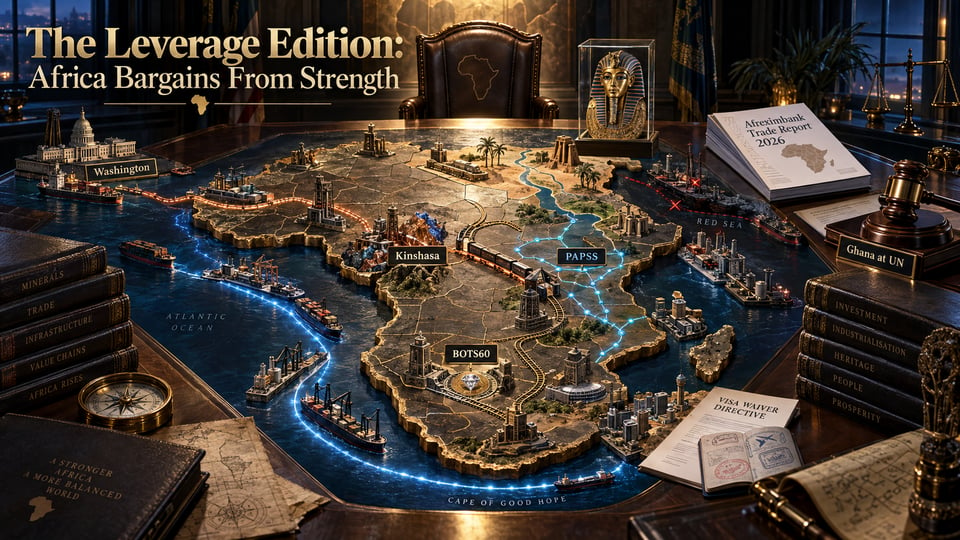
This week the world came to negotiate, and Africa set the table. Kinshasa stood up a task force to fast-track its minerals partnership with Washington. Washington spent a full day at a flagship policy forum asking, in effect, how to win more of the continent's business. Afreximbank published a 2026 trade report telling Africa to industrialize on the back of great-power competition rather than fear it. And at the United Nations on Tuesday, Ghana takes the case for reparatory justice to the world stage. Between those poles, the week also delivered a heritage repatriation in Cairo, a visa-backlog milestone in Pretoria, a payments-rail acceleration across the continent, and a Diamond Jubilee taking shape in Gaborone. The debut edition of the Signal walks all six sections of the African week, with twenty references and no borrowed voices. Pro-Africa, evidence-first, and in our own voice: leverage is the story, and leverage is the standard we hold ourselves to.
African Culture and Heritage
A 2,000-year-old face comes home
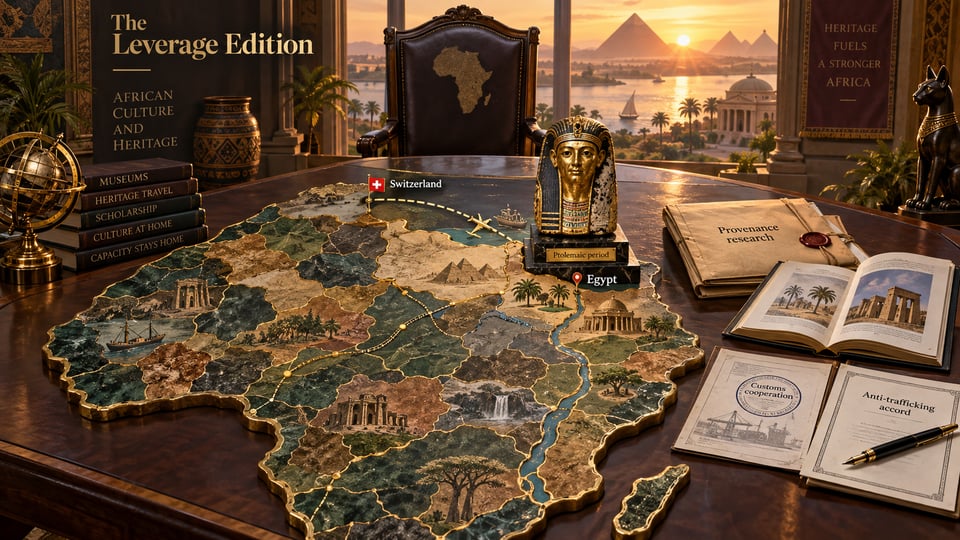
On 16 September, Switzerland repatriated an ancient funerary mask from the Ptolemaic period to Egypt. The Swiss Embassy in Cairo announced the return as part of a standing bilateral partnership to safeguard cultural heritage and to combat the illicit trafficking of antiquities [1].
Every returned object narrows the space where African heritage is treated as a global commodity. What distinguishes this return is the machinery behind it. This was not a one-off gesture staged for a photograph; it was the product of a framework agreement that treats trafficking as an organized problem requiring organized answers: provenance research, customs cooperation, and public announcement as both pressure and precedent [1].
The object itself carries the argument. The mask is roughly 2,000 years old, made in the era when the Ptolemaic dynasty ruled from Alexandria, one of the many chapters in which Africa's cultural production and the continent's political history were inseparable. An artifact of that depth going home under an anti-trafficking accord is restitution doing its quiet, compounding work [1].
The direction of travel matters as much as the objects. Restitution is shifting from symbolism to system, from negotiated exceptions to standing frameworks that outlast particular governments and particular museum directors. A framework converts each return from an ending into a precedent: the next claim can point to the last one, and the burden of explanation shifts from the country asking for its property to the institution still holding it [1].
There is a second-order effect worth naming, because it is where culture becomes economics. Each return reattaches an object to a living audience, and living audiences build institutions around what they can see: museums that draw visitors, scholarship that draws students, and the heritage travel this issue's second section traces through Egypt's Faiyum Oasis. Culture coming home is also capacity staying home, and capacity compounds the way frameworks do [1] [4].
The signal to watch between now and the next edition is which European institutions convert individual returns into permanent return mechanisms. Gestures end. Frameworks compound.
Travel and Exploration
The continent opens, one waiver at a time
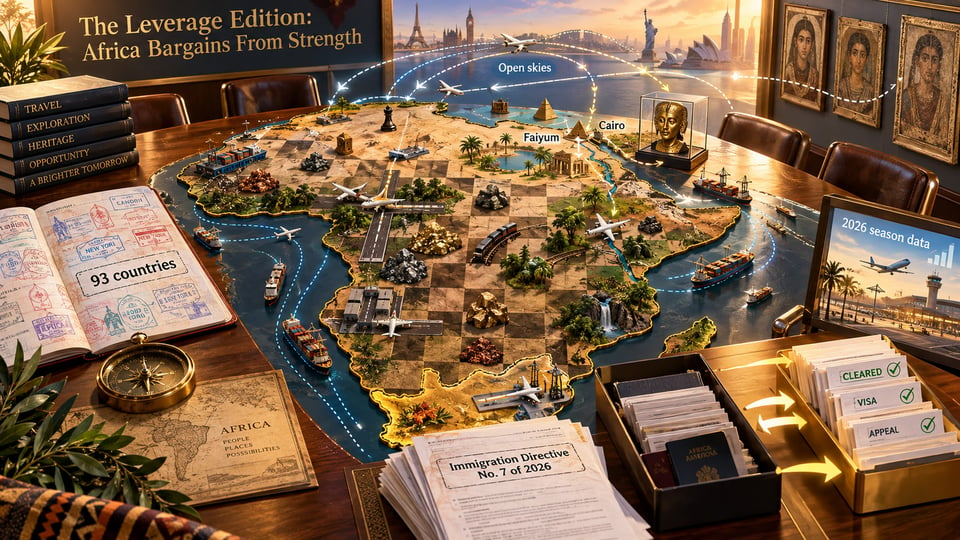
South Africa's Department of Home Affairs has extended its concession for pending waiver, visa, and appeal applications while reporting significant progress clearing the historic backlog that once trapped travelers in administrative limbo, formalized in Immigration Directive No. 7 of 2026 [2]. Read the directive closely and it says two things at once: the backlog era is ending, and the department would rather extend lawful status for applicants with pending outcomes than punish people for its own historical delays. That is a department negotiating for credibility, which is exactly what a tourism economy needs from its gatekeepers [2].
The wider picture is bigger than one department. Open-skies momentum and a waiver regime now covering 93 countries are reshaping 2026 travel to the continent [3]. For the reader planning a trip, the practical meaning is straightforward: the list of places reachable without months of paperwork is growing, and the processing system behind those exceptions is being repaired in public view rather than in promises [2] [3].
The stakes are economic, not cosmetic. Tourism is among the fastest foreign-exchange earns available to African economies, and every friction point between intention and arrival lands directly on the ledger: a delayed waiver is a postponed booking, and a postponed booking is revenue that some competing destination collects instead. A processing system that clears its backlog while extending waivers is a system converting interest into arrivals, and arrivals are the raw material of the hotel, guiding, transport, and craft economies behind every headline destination [2] [3].
Destination spotlight: Faiyum. A new travel feature traces Egypt's 2,000-year-old funerary portraits from a museum wall in Cambridge, Massachusetts back to the oasis where they were painted, following the portraits the way a pilgrim follows a story to its source [4]. The trip works because the objects are the attraction, which makes the repatriation economics of this issue's first section a travel story too: heritage that is present draws the world; heritage that is absent draws someone else's visitors [1] [4].
The checkpoint for the next edition is whether waiver progress and open-skies momentum convert into measurable arrival growth in the 2026 season data. Policy has moved. The receipts have not yet answered [2] [3].
History and Identity
Botswana at sixty
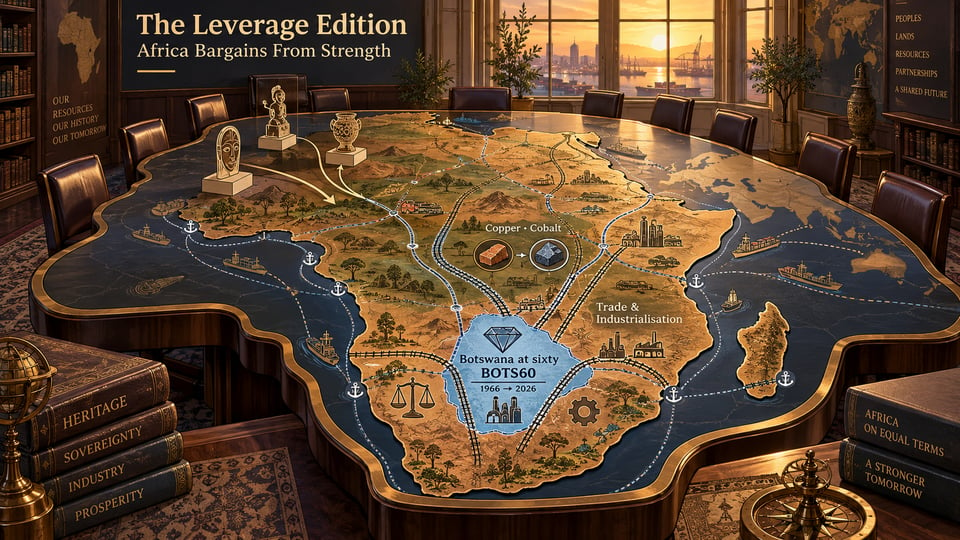
On 30 September, Botswana marks 60 years of independence with the official BOTS60 Diamond Jubilee, whose visual identity the government has now unveiled [5].
The number deserves context, because the context is the achievement. In 1966, Botswana entered independence among the poorest states on earth, a landlocked country with little infrastructure and fewer expectations. Six decades later it stands as one of Africa's longest-running multiparty democracies and an upper-middle-income economy, the documented record of a state that negotiated its mineral wealth rather than surrendering it [5]. The arrangement Botswana built in the early independence years, revenue share first, local capacity second, ownership ambition held in reserve, remains one of the quiet victories of African statecraft: proof that the bargaining table, not the barrel, can be the instrument of sovereignty.
The jubilee is therefore not nostalgia. It is a data point in the argument that African institutions can hold, convert, and compound, delivered by a country that had every excuse to fail [5]. Anniversaries of successful states do double duty: they consolidate the national story at home, and they arm the diaspora and the continent's advocates abroad with a counterexample to every lazy narrative of inevitable failure.
The deeper frame comes from Afreximbank's African Trade Report 2026, themed Leveraging Geopolitics for Trade and Industrialisation in Global Africa, which argues that shifting geopolitics offer Africa a rare window to industrialize on its own terms [6]. Read against Botswana's sixty years, the report is the modern chapter of the independence generation's bargain: convert natural wealth into built capacity, and do it before the window closes [5] [6]. Botswana converted diamonds into schools, roads, and institutions. The question the report puts to every capital on the continent is whether this generation will convert copper, cobalt, and lithium the same way, or merely export the opportunity [6].
That question is already live. Battery-era demand gives the transition metals the strategic weight diamonds once carried, and how Botswana and its neighbors negotiate this wave will decide whether BOTS120 celebrates institutions or interrogates them [12] [13].
Business and Opportunity
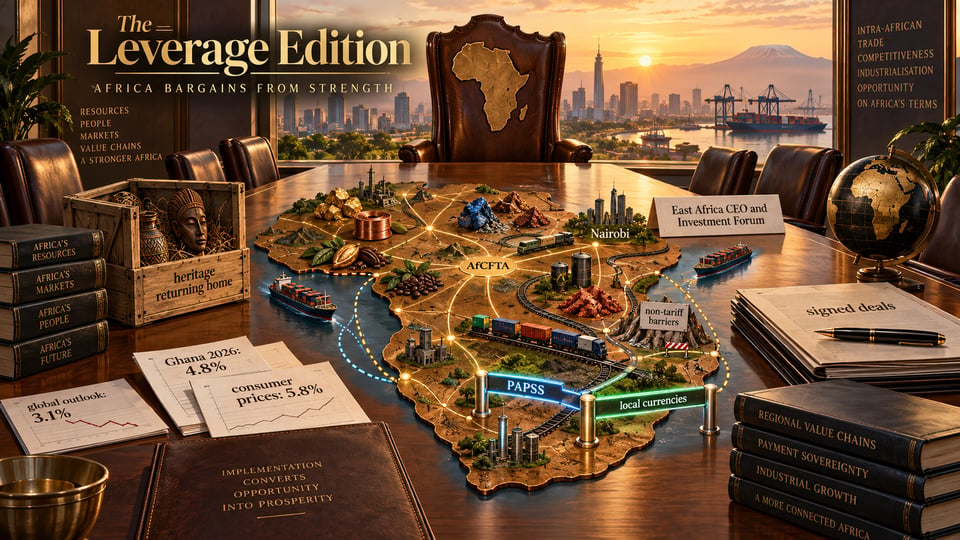
CEOs demand speed, and the plumbing is arriving
The inaugural East Africa CEO and Investment Forum closed in Nairobi on 18 September with a direct call from senior government officials, business leaders, investors, and development finance institutions for stronger implementation of regional integration commitments, improved investment conditions, deeper regional value chains, and greater access to finance [7]. The two-day, CEO-led platform, the first of its kind for the East African Business Council, put the region's friction points on the record: non-tariff barriers, regulatory fragmentation, high energy costs, and weak industrial linkages [7] [8].
It is easy to file forum language under boilerplate. It is harder when the ask is implementation rather than announcement: the communique's emphasis was deal conversion, faster execution of integration commitments already made, and finance reaching firms that can actually deploy it [7]. That is the language of people who have signed the memorandums, built the PowerPoint, and are still waiting for the follow-through. When the region's CEOs put their name to a demand for speed, the demand itself is a signal: the opportunities are real enough that the friction is no longer tolerable [7] [8].
The plumbing is arriving in parallel. On 11 September, the Pan-African Payment and Settlement System (PAPSS), the financial infrastructure layer of the AfCFTA, announced its next strategy phase after significant network expansion and strong growth in payment volumes and values [9]. PAPSS exists to settle cross-border transactions in local African currencies, which sounds technical until you follow the money: every payment that clears without routing through hard currency abroad is a transaction cost removed from intra-African trade, a hedge against dollar scarcity built into the rails themselves, and a small act of monetary sovereignty performed millions of times a year [9]. Integration on paper becomes integration on an invoice.
The macro numbers argue for urgency. The IMF projects Ghana's 2026 growth at 4.8 percent with consumer prices at 5.8 percent [10], and has lifted the country's growth estimate from 4.6 to 4.8 percent with inflation seen at 7.9 percent, against a global outlook downgraded to 3.1 percent [11]. African markets compounding near five percent while the world slows is the quiet headline of this cycle, and it reframes the Nairobi forum: this was not a gathering asking for rescue, but a growth region demanding its own infrastructure catch up with its own numbers [10] [11].
Two indicators to watch before the next edition: PAPSS transaction volumes as the strategy phase begins, and whether Nairobi's forum language converts into signed deals with dates attached [7] [9]. Speed demanded is a signal. Speed delivered is a story.
Geopolitics and Global Standing
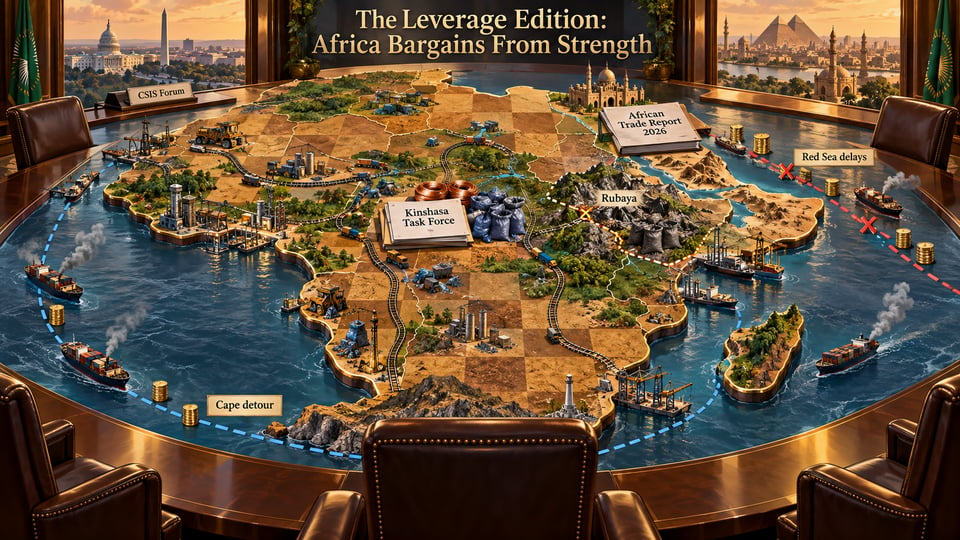
The minerals-diplomacy week
The week's spine ran through three capitals, and each stop made the same point from a different angle.
In Kinshasa, the Democratic Republic of Congo approved a task force, per cabinet minutes dated 11 September seen by Reuters, to speed implementation of its strategic minerals partnership with the United States, as the government works to attract more Western investment into copper and cobalt [12]. A task force is bureaucratic language for an admission: the leverage is real, the window is open, and execution is now the bottleneck. Countries do not stand up implementation machinery for partnerships they intend to let drift [12].
In Washington, CSIS convened senior US and African officials, industry leaders, investors, and development finance experts for a daylong flagship forum on the future of US-Africa minerals and energy cooperation [13]. When the policy establishment of the world's largest economy spends a full day asking how to structure commercially viable minerals partnerships with the continent, the direction of approach has changed. Africa is being courted for what it holds, which is a stronger negotiating position than being lectured about what it lacks [13].
And in Cairo, the doctrine arrived in print. Afreximbank's African Trade Report 2026 argues that great-power competition over supply chains is an opening for African industrialisation rather than a hazard to be managed from the sidelines, and urges the continent to trade geopolitical competition for built capacity [6]. Kinshasa's task force is the doctrine in miniature: make partnership the price of access to the rocks the transition needs, and make local processing part of that price [6] [12] [13].
Leverage without logistics, however, is a bluff, and the week's cautionary ledger is written at sea. UNCTAD documents ships that once passed the Red Sea in days now sailing for weeks around the Cape of Good Hope, with developing countries hit hardest by the delays, costs, and emissions of rerouting [14]. Renewed insecurity since late February 2026 has pushed carriers back into detours, with disruption surcharges raising landed costs at African Indian Ocean ports [15]. The strategic irony is sharp: the continent holds the rocks, and someone else still charges rent on the routes [14] [15]. A leverage strategy that ignores shipping lanes is a strategy that pays away its winnings at the port gate.
The contested seam runs through Rubaya. Monitoring compiled by allAfrica reports coltan from the DRC's Rubaya area moving through Rwanda into international markets, flows that sustain armed actors and complicate every minerals partnership that assumes clean supply chains [16]. Rwanda's position on these flows is a matter of standing dispute; this Signal reports the monitoring, not a verdict, and asserts no state complicity [16]. What is not disputed is the sector it touches: the same copper-and-cobalt complex the new task force is racing to organize [12] [16]. Any partnership built on Congolese minerals inherits this question with the ore.
The Signal's analysis, stated as our own: Africa's leverage is real, current, and being tested in real time. This week showed both halves of the test, the bargaining power the minerals enable and the chokepoint rent the routes still extract. The states that convert the first into ports, rails, refineries, and their own shipping capacity will define the decade. The states that do not will spend the decade signing task forces [6] [12] [14].
Community and Connection
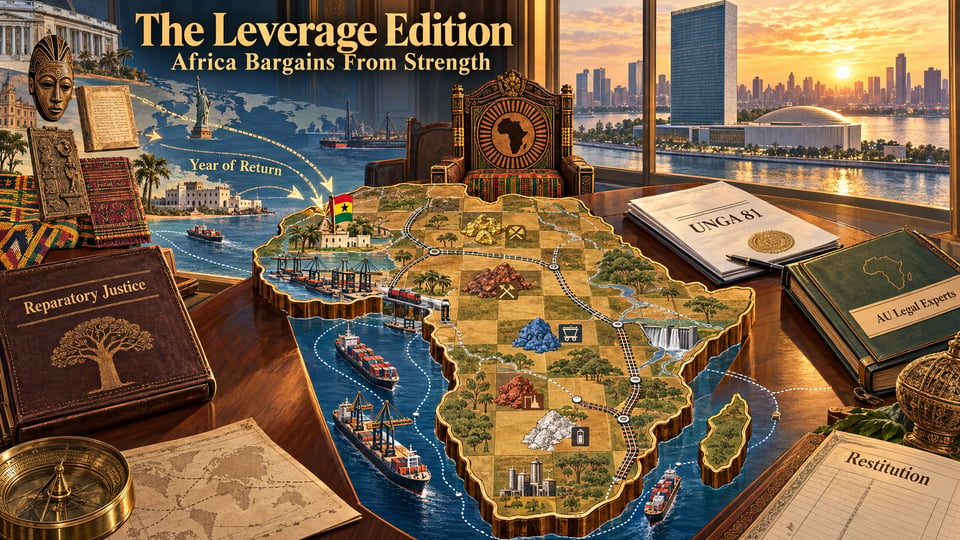
Reparatory justice goes to the United Nations
On 23 September, Ghana hosts a high-level side event on reparatory justice at the 81st UN General Assembly in New York, described by organizers as another major step in the campaign for justice, restitution, and dignity for Africa and people of African descent worldwide [17]. Ghana's own Permanent Mission to the United Nations frames the gathering as the moment the campaign's established panels report their progress, an invitation, in the mission's words, for the world to bear witness to that momentum [20].
Ghana's state broadcaster frames the push as the extension of the Year of Return legacy, positioning the country as cultural and spiritual home for the global diaspora, with reparations deepening connections that tourism alone cannot [18]. The two framings are the same strategy at different altitudes: the memory work brings the diaspora home, and the legal work brings the case to the world's table.
The campaign now has machinery, not just memory. The African Union Reference Group of Legal Experts on Reparations is mandated to provide legal counsel, guiding principles, and Afro-centric frameworks for the continent's pursuit of reparatory justice, per Ghana's foreign ministry documentation [19]. Read that sentence again at continental scale: a standing legal apparatus, a continental mandate, a sponsoring state, and now a UN venue with progress reports due [18] [19] [20].
Whatever one's position on the remedies, the organizational reality is new. Reparations have moved from moral argument to institutional agenda, and Africa and its diaspora are negotiating as a bloc, the same bloc-building logic this issue traces in minerals and trade [6] [19]. The connection is the Signal's own: leverage in one arena builds the confidence and the coalition for the next.
Watch one thing on Tuesday: whether the event produces a negotiated text or a statement of process. A text means the campaign has entered the bargaining phase. A statement means the machinery is still being built. Either way, the venue has changed, and venues do not change back [17] [20].
Liked this issue? Forward it to a colleague who needs to see Africa clearly.
Subscribe to The Noble Africa Signal
References
Egyptian Streets. "Switzerland Repatriates 2,000-Year-Old Egyptian Funerary Mask." https://egyptianstreets.com/2026/09/16/switzerland-repatriates-2000-year-old-egyptian-funerary-mask/ Accessed 2026-09-19.
South Africa Department of Home Affairs. "Concession of 30 March 2026 (Immigration Directive No. 7 of 2026)." https://www.dha.gov.za/images/PDFs/Concession_of_30_March_2026.pdf Accessed 2026-09-19.
Rio Times Online. "Africa Visa-Free Travel Push Opens the Skies in 2026." https://www.riotimesonline.com/africa-visa-free-travel-open-skies-2026/ Accessed 2026-09-19.
africa.com. "Chasing Ancient Faces Through the Faiyum Oasis." https://www.africa.com/travel-africa/chasing-ancient-faces-through-the-faiyum-oasis Accessed 2026-09-19.
Government of Botswana. "BOTS60 Official Logo, Diamond Jubilee, 60 Years of Independence." https://www.facebook.com/BotswanaGovernment Accessed 2026-09-19.
Afreximbank. "African Trade Report 2026: Leveraging Geopolitics for Trade and Industrialisation in Global Africa." https://research.knowledge.afreximbank.com/digital-content/african-trade-report-2026-leveraging-geopolitics-trade-and-industrialisation-global Accessed 2026-09-19.
East African Business Council. "East Africa CEO and Investment Forum 2026 Calls for Faster Regional Integration, Investment and Deal Conversion." https://eabc-online.com/east-africa-ceo-investment-forum-2026-calls-for-faster-regional-integration-investment-and-deal-conversion/ Accessed 2026-09-19.
East African Business Council. "EABC East Africa CEO and Investment Forum 2026." https://eabc-online.com/event/eabc-east-africa-ceo-investment-forum-2026/ Accessed 2026-09-19.
Afreximbank. "PAPSS Targets Accelerated Adoption and Transaction Growth as Network Expands Across Africa." https://www.afreximbank.com/papss-targets-accelerated-adoption-and-transaction-growth-as-network-expands-across-africa/ Accessed 2026-09-19.
International Monetary Fund. "Ghana and the IMF." https://www.imf.org/en/countries/gha Accessed 2026-09-19.
MyJoyOnline. "IMF Revises Ghana's Growth Rate for 2026 to 4.8%, Inflation at 7.9% Despite Global Economic Pressures." https://www.myjoyonline.com/imf-revises-ghanas-growth-rate-for-2026-to-4-8-inflation-at-7-9-despite-global-economic-pressures/ Accessed 2026-09-19.
Reuters. "Congo Creates Task Force for US Minerals Deal, Cabinet Minutes Say." https://www.reuters.com/world/china/congo-creates-task-force-us-minerals-deal-cabinet-minutes-say-2026-09-15/ Accessed 2026-09-19.
CSIS. "The Future of U.S.-Africa Minerals Diplomacy." https://www.csis.org/events/future-us-africa-minerals-diplomacy Accessed 2026-09-19.
UNCTAD. "Review of Maritime Transport 2025." https://unctad.org/publication/review-maritime-transport-2025 Accessed 2026-09-19.
BISI. "Red Sea Disruption: Real Cost to African Trade in 2026." https://bisi.org.uk/reports/red-sea-disruption-real-cost-to-african-trade-in-2026 Accessed 2026-09-19.
allAfrica. "Africa: All of Africa Today, September 15, 2026." https://allafrica.com/stories/202609150121.html Accessed 2026-09-19.
Ghanaian News Canada. "Ghana to Host High-Level UN Event on Reparatory Justice During 81st General Assembly." https://ghanaiannews.ca/ghana-to-host-high-level-un-event-on-reparatory-justice-during-81st-general-assembly/ Accessed 2026-09-19.
GBC Ghana Online. "Ghana to Host Historic Reparative Justice Summit as Mahama Leads Global Push." https://www.gbcghanaonline.com/general/ghana-reparative-summit/2026/ Accessed 2026-09-19.
Ministry of Foreign Affairs of Ghana. "National Dialogue on Reparations: Next Steps Book." https://mfa.gov.gh/wp-content/uploads/2026/06/LZ31Bq_9529930e96efba4c-1.pdf Accessed 2026-09-19.
Permanent Mission of Ghana to the United Nations. "Ghana to Host High-Level Side Event on Reparatory Justice at UN General Assembly." https://www.ghanamissionun.org/09152026-2/ Accessed 2026-09-21.